Adult education is a specific field because the participants are people of different ages with different life experiences, prior knowledge, and motivation. In working with such groups, an individualized approach is definitely needed because the groups are mostly mixed, and the participants are very different. My lectures were related to the use of digital technologies.
I had to be very resourceful and apply methods that had to be adapted to the participants
For example: When I was preparing the classes, it did not even occur to me to print any of the materials because the goal was to teach the participants how to navigate the digital world. During the classes, it turned out that some people did not manage well when they had several open pages or documents open on the screen at the same time, so I still decided to give them part of the materials on paper. With that adjustment, they were able to follow much more easily because they had something familiar to them and in that way could more easily understand what was new to them as well. That situation also reminded me that everything is not always as we plan and that in this way my lectures were much more useful than if I had continued insisting only on digital materials. The goal is not for the class to be perfect, but for the participants to get something useful from it.

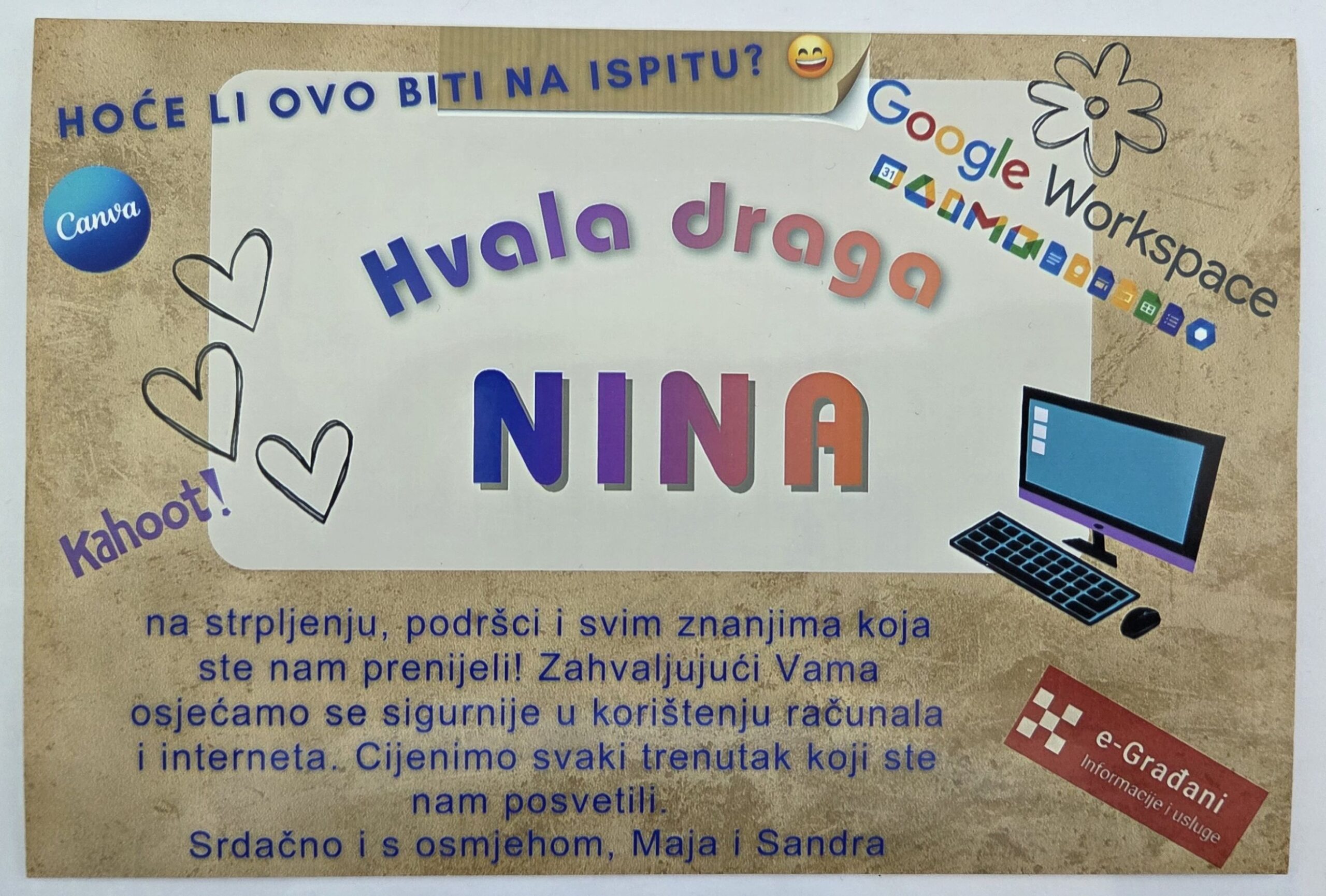
Nina Posavec (teacher in Orsus- Adult Education Centre)
Also, I think it is important to connect the material with everyday life and real situations. That is what interests people and in what they can see the concrete application of the material. So, I adapted a lot of the material along the way and instead of using my own examples, I used theirs. One of my favourites was when I shared with them the recipe for cakes that one participant brought to class. That motivated them much more to use technology in their free time in order to find the recipe than when I shared my own materials that I had prepared in advance. Not everyone is interested in everything, but finding everyday situations and connecting them with what we do is always something that helps put things into perspective and connect theory and practice.
One participant shared that she had always been intimidated by working on a computer and found it very stressful, but once she discovered what it could actually do, she became motivated to continue learning and pursue better job opportunities.
It was also very important to me to continuously support and encourage them, motivate them to try things on their own, look for solutions, and realise that it was perfectly okay not to get everything right on the first attempt. People are often hesitant to try something new because they are afraid of making mistakes. Through the classes and practical examples, I wanted to show them that most mistakes can be corrected and that nothing terrible happens if something goes wrong. In fact, this experience confirmed to me how important it is to create a supportive and relaxed learning environment where people feel safe to experiment, ask questions, and learn at their own pace.
Also, I am glad that in the classes I used some form of learning through play, which is not something often used in adult education. At first, I was also sceptical about how it would turn out and whether people would accept it, but it proved to be a very good method for breaking the monotony, creating a more positive atmosphere, and helping people connect. In the end, it also proved to be a very effective learning tool because it is definitely easier for us as adults to learn when the material is presented in a fun and interactive way.
What these lectures reminded me of is how important it is to see people as individuals, listen to them, and try to understand their perspective. The fact that learning is a process influenced by many external and internal factors is often overlooked, and the role of the lecturer is not only to share knowledge, but also to guide and support participants throughout that process.
Teacher, Nina from Orsus