The industry of second-hand shops: learning happens together
An industry that realises two Dutch ‘Reskilling Labs’ of the European RESCALE project
Roel Beumer, Liza Hoefnagels & Marijn Kamerbeek
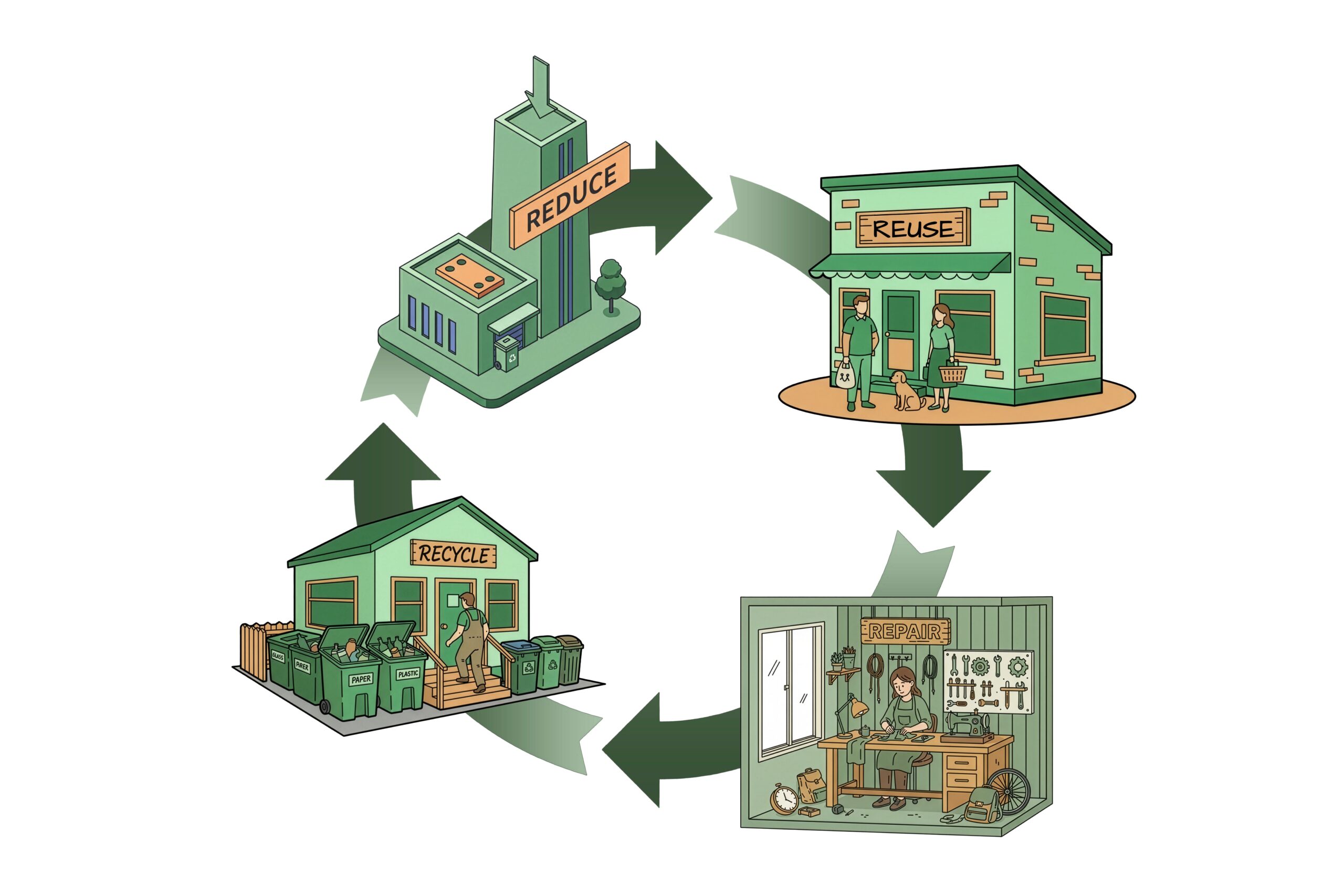
The industry of second-hand shops has been in existence for 40 years. It refers to concepts such cycle and circulation. It is an apt metaphor for the development of the Dutch industry of second-hand shops itself. Since the opening of the first second-hand shop in Dieren on 7 March 1981, the industry has been moving in a continuous cycle of growth, change and reinvention. What began as an idealistic response to waste and poverty has since grown into a mature social concept in which circular reuse and human development go hand in hand. Roel Beumer, Liza Hoefnagels and Marijn Kamerbeek briefly describe the history and what this means for the professionalisation of the second-hand shops industry and the development of its staff. In order to optimise the professionalisation they use the developed RESCALE learning model and two of the second-hand shops are two of the ‘Reskilling Labs’ of the European project RESCALE.
In this article, we look back on forty years of development in the industry. We base this on sources detailing the origins of second-hand shops and on interviews with two key figures from the modern wave of professionalisation: Harry Slotema, former director of the Dutch Second-Hand Shop Association (BKN), and Onno in ’t Veld, director of the 2Switch second-hand shop in Arnhem and involved with the Dutch Second-Hand Shop Quality Mark from the outset. Together, they paint a rich and multifaceted picture of an industry that is becoming increasingly professional, yet never loses sight of its social roots.
The idealistic driving force
The first second-hand initiatives in the 1980s were entirely reliant on volunteers. The industry was driven by idealism: reducing waste, supporting vulnerable residents and strengthening local communities. The structure was informal, but the motivation was strong.
Around the 1990s, the second-hand industry developed further into a cultural meeting place. The composition of the workforce also seemed to change. It was no longer just volunteers who were working there, but also people facing barriers to the labour market. This growth was evident quite early on at organisations such as ‘Rataplan and Het Goed. Rataplan had a clear mission: “an independent, non-profit foundation that provides work for people who are distanced from the labour market and promotes reuse.” Despite the strong motivation and clear goals, professionalisation was slow to get off the ground.
The first steps towards professionalisation
After 2000, the second-hand industry was increasingly seen as the place for reintegration. When Harry Slotema became director of Kringloop De Beurs in Oldenzaal in 2003, the industry was in a transitional phase. Shops were often cluttered, managers had little experience with ‘retail’, and customer service was largely intuitive. In other words, many second-hand shops were well-intentioned initiatives, but lacked a solid foundation. Slotema describes the situation at the time as “in some cases quite amateurish, a bit of a shambles”. There was a lack of knowledge, structure and support.
Yet the industry was surprisingly innovative. Together with the BKN, Marcel Brouwer of Tussen Kunst en Kitsch set up a valuation course, as dealers often knew better what the items were worth than the organisations themselves. Training courses were also introduced focusing on customer contact, integrity and visitor guidance. In addition, a cross-border digitisation project was underway that made the entire flow of goods visible, from intake to sale. All three of these initiatives demonstrate that the drive towards professionalisation began with a growing need from the companies and employees themselves: more knowledge, more growth and more craftsmanship.
The birth of the quality mark
The same need arose within the BKN. Around 2008, there was a growing desire to develop an independent quality standard. The industry was struggling with its image and a lack of professional management. As Onno in ’t Veld explains: “There was a great need for professionalisation. We had to set ourselves apart and demonstrate that we are reliable partners for local authorities and other stakeholders.”
The Kringloop Nederland Quality Mark was created with the aim of serving as an internal tool to support organisations in their professionalisation. Kringloop Eemnes was the first certified organisation, with many others following. By 2020, all members had joined. Although the quality mark was initially set up as an internal tool, it unexpectedly gained significant external value: local authorities included it in tenders, partners referred to it in contracts, and it became a visible sign of quality. The quality mark thus became the driving force behind professionalisation: the second-hand shops themselves had to invest in implementing the guidelines and complying with them.
Dealing with a government that is stepping back
In 2010, the government withdrew further from the funding of reintegration, with the result that the financial scope for human development shrank. According to Onno, that “pressure was a key driver of entrepreneurship in the industry: you had to innovate in order to continue investing”.
At the same time, Onno warns against the loss of local connection: many second-hand shops are deeply rooted in their local community, know the local partners and are aware of what is going on. Regional or national structures may be efficient, but they carry the risk of creating distance.
Despite the many changes, one key objective remained: providing opportunities for people. Slotema explains how four employees in so-called Melkert jobs, considered ‘not suitable for progression’, eventually all found permanent roles outside the second-hand shops.
Today’s challenges
In 2025, the industry once again faces major challenges: digitalisation, competition in the second-hand market, circular economy objectives, and the need to demonstrate the social value of human development. Innovation is essential, but maintaining a human touch and inclusive workplaces is just as important.
The pursuit of a circular economy, the creation of an inclusive labour market and responding to these technological and societal changes also require substantial investment in a learning culture, in which learning and development take place continuously.
Meanwhile, pressure from national authorities is increasing. They expect more from reintegration programmes, making the professionalisation of learning and development increasingly important. In light of this, a Good Practices meeting was held on 13 October 2023 with BKN employers to discuss the possibility of establishing an Academy. The need for professionalisation was confirmed at this meeting. Employers indicated that a joint platform offers added value by increasing knowledge and skills, preparing them for the future and strengthening the industry as a whole. Making visible and collecting what is available, and using that to accelerate progress as much as possible in various areas where this is still in its infancy, was seen as an essential part of this. In designing the academy, the focus is on a structure centred on content and level, with everything revolving around personal development.
In this context, professionalisation is increasingly becoming a continuous cycle: a true cycle. It requires organisations to continue investing in learning, development and collaboration. This creates scope for new industry-wide initiatives, including the further expansion of the Academie Kringloop Nederland: a ‘hub where knowledge sharing, craftsmanship, leadership and people-centred development come together’.
Learning is something you do together
The academy’s focus is on the professionalisation of the industry, and more specifically on promoting Lifelong Learning and Development. This means creating structural opportunities for the continuous development and strengthening of the skills and knowledge of second-hand shops industry employees. This developmental framework supports not only the participants, but also employees and work supervisors in their daily work.
Within the Academie Kringloop Nederland, professionalisation takes shape through a clear and coherent structure of development themes, learning pathways, modules and teaching materials. This framework provides a solid foundation for an industry in which continuous development is central. For this framework among others the developed RESCALE learning model has been used. Part of this framework are:
- Development themes
The academy offers three development themes: Basic Recycling Skills, Circular Skills, and Leadership and Supervision Skills. Each development theme includes a wide range of different learning pathways.
- Learning pathways
A learning pathway consists of several modules that together focus on a single specific topic. As employees progress through the modules, they build up their knowledge and skills step by step.
- Modules
A module is a defined learning unit that forms part of a learning pathway. Each module covers new material and varies in terms of teaching resources.
- Teaching materials
These come in various forms: videos, e-learning modules, assignments, presentations and work instructions.
Recognising growth is a key component of the academy. Upon completing the learning pathways and modules, organisations can award badges or certificates to their staff as part of the recognition and appreciation process. Such recognition can mean a great deal to staff. Proof of what they have learnt – something tangible they can be proud of – contributes to their motivation and retention. This was also evident following the academy’s pilot phase: employees responded enthusiastically to the personalised certificates. Ultimately, recognising this growth will lead to attracting and retaining staff, a crucial factor for the industries’ agility.
All in all, the platform is not just about individual progress, but also strengthens the collective structure. In doing so, the academy underlines the essence of sustainable professional development: “learning is something you do, together”.
The past forty years
Looking back over the past forty years, the second-hand shops industry has undergone an impressive transformation: from idealistic pioneers to mature social enterprises that play a crucial role in circularity and inclusion. History shows that the industry continually reinvents itself out of necessity, but also out of a deep conviction that both things and people deserve a second chance. At the moment two second-hand shops in the Netherlands realised two ‘Reskilling Labs’ as part of the European RESCALE project in order to give their employees the opportunity to rescale their skills and strengthen their position in daily life and on the labour market. Professionalisation of this industry is not an end point in this process, but a movement which, just like the circular economy itself, remains in a constant cycle.
© volwassenenleren.nl (2026)
After completing a vocational qualification, Liza Hoefnagels studied International Development Management at Van Hall Larenstein. She worked, among other things, at the Rotterdam-Rijnmond Safety Region as a policy officer for Professional Competence and later as a team coordinator for Sustainable Education Programmes for secondary and vocational education. She is now project leader at the Dutch Second-Hand Shops Industry Academy within the Dutch Second-Hand Shops Industry Trade Association. Sustainability and inclusion are central to her work. She is also training to become a biodynamic therapist.
“Within the circular economy, you can learn and develop in your own way and at your own pace; that’s what makes this industry so special.”
Marijn Kamerbeek is currently a final-year Master’s student in Communication Science at Radboud University in Nijmegen. She recently started working as a student internally in Communications at the BKN, where she is helping to set up and further develop the Dutch Second-Hand Shops Industry Academy. With her background in design, strong writing skills and curiosity about the sustainability industry, she brings a fresh perspective to the project team.
References
Emmaus Domstad. (2026). The history of charity shops. Retrieved: 04-03-2026.
Encyclo. (2026). Thrift shop – meaning and synonyms. Retrieved: 04-03-2026.
Het Goed. (2026). How it all began. Retrieved: 04-03-2026.
In ’t Veld, O. (2025). Interview by the Dutch Thrift Shop Association (unpublished; internal source material).
Slotema, H. (2025). Interview by the Dutch Second-Hand Shops Industry Trade Association (unpublished; internal source material).
Rataplan Foundation. (2026). History of the Rataplan Foundation. Retrieved: 04-03-2026.
Copyright of the owner of the picture: Gerd Altmann.